

Brown Bag Test For Lipids
Food Chemistry Scientific discipline Projects + Video
Unlike foods provide different nutrients, similar vitamin C, carbohydrates, and lipids. Can you effigy out what you lot're getting from your favorite food? Use these three simple chemical science tests to sleuth it out. (Notation: Adult supervision required when working with chemicals.)
Science Project Video – Vitamin C
What You lot Need:
- Nutrient samples: saltine crackers, fruit juices, peanut butter, bread, egg white, applesauce, milk, yogurt, etc.
- Benedict's solution (glucose indicator)
- Indophenol (vitamin C indicator)
- Brown paper handbag (for lipid examination)
- Big test tubes
- Pipets
- Plastic lab frock
- Nitrile safety gloves
- Or buy the complete Food Chemistry Experiment kit
Stop the Scurvy – Vitamin C Examination
What foods have vitamin C? Practise oranges have more than lemons? Do a simple chemical science exam to find the answer.
1. Choose several different things to test for vitamin C: tomato juice, orange juice, lemon juice, mango, kiwi, etc. You may likewise cull a food product that says it has vitamin C added. (If it is a solid, grind it upwardly and mix with water to brand a solution.)
2. Make some indophenol solution by combining a small amount (less than ane/8 teaspoon) with one loving cup of water. Stir until it is well mixed.
3. Put xv drops of indophenol solution into a examination tube.
four. Add one of the juices you chose to the indophenol drop by drop. Tape how many drops it takes to plow the blue indophenol colorless.
5. Repeat with the other juices and compare the number of drops of each that yous added. 3
Vitamin C is a vital nutrient for humans that aids our immune organisation and helps foreclose disease. Many animals tin brand their own vitamin C, but humans must go it from their nutrition, which is why the vitamin C content of the food we swallow is important. At one fourth dimension a disease called scurvy was common among sailors, because they had no admission to fruits and vegetables at ocean. Scurvy is caused by a lack of vitamin C.
Indophenol is an indicator that turns colorless in the presence of vitamin C. The fewer drops of juice you demand for the colour change, the college the vitamin C content in the juice. Which fruits had the most vitamin C? Do you think different preserving methods (canning, drying, freezing) has an effect on vitamin C? Do some more than tests to find out!
Saccharide and Starch – Glucose Test
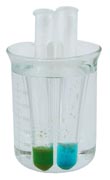
- Make full two exam tubes with an inch of Benedict's solution each. To one add together 15 drops of the saltine-and-water solution, to the other add together the saltine-and-saliva solution. (Utilize ii different pipets and characterization the test tubes so yous can tell them autonomously.)
- Make full a glass with boiling water so prepare the test tubes in it and look for three minutes. Remove the test tubes from the hot water and allow them to cool. Swirl the contents and observe the color of the liquid. Is there a difference between the 2?
Glucose is a simple sugar (sugar) that plants produce past the process of photosynthesis. It is the chief source of energy for our trunk's cells, and is able to enter our bloodstream speedily to provide energy right away. Without glucose, our bodies wouldn't function! Plants shop extra glucose in a more complex carbohydrate called starch. During digestion, our bodies break the starch back downwards into glucose for our cells to use as an energy source.
In this project yous saw that process in activeness. Saltine crackers accept lots of starch. When y'all chewed 1 of the crackers, an enzyme in your saliva, called amylase, started to intermission the starch down into glucose. Benedict's solution is a glucose indicator that changes colors based on how much glucose is present. Green, yellowish, orange, or red indicates the presence of glucose. The color difference in your 2 test tubes proves that the chewed-up cracker contained glucose while the other didn't.
Looking for Lipids – Fat Test
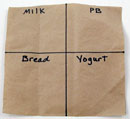
- Cutting off the side of a brown paper bag so y'all have a sheet of chocolate-brown paper.
- Make solutions of several different foods yous want to test for lipids. (You tin try milk, peanut butter, yogurt, bread, etc.) Mix 1/2 teaspoon of ground food with 1 teaspoon water.
- Use a permanent marking to divide the brown newspaper into several sections and characterization each department with the name of one of the foods, equally in the picture on the right.
- Put three drops of each food solution on the newspaper in its section. Use a make clean pipet for each test. Also, test water in one department to show the result with a substance that doesn't have whatever lipids.
- Wait a few minutes until the liquid has evaporated. Hold upwardly the paper to the light and look at each spot. The foods that contain lipids will leave a greasy mark that turns the brown paper translucent. Which foods have lipids? Are some of the greasy spots bigger than others?
Lipids are fats and oils, made of molecules that don't dissolve in water. They are very important for our body functions because they transport vitamins, help grade cell walls, and store energy long-term. Eating also much fat can be very unhealthy, but every good diet volition contain a moderate amount. How many of the foods y'all tested contained lipids? Effort comparing food that has a "regular" version and a "depression-fat" (or "not-fat") version. Is at that place a divergence between the spots left by skim milk and whole milk?
Store our full choice of chemical science supplies such as 600ml beakers, the beginner chemistry ready, lab scissor jack, buy potassium permaganate along with other chemicals, student thermometers, and more.

Brown Bag Test For Lipids,
Source: https://learning-center.homesciencetools.com/article/food-chemistry-projects/
Posted by: springponly1993.blogspot.com
0 Response to "Brown Bag Test For Lipids"
Post a Comment